
Entity Intelligence
What this page is about
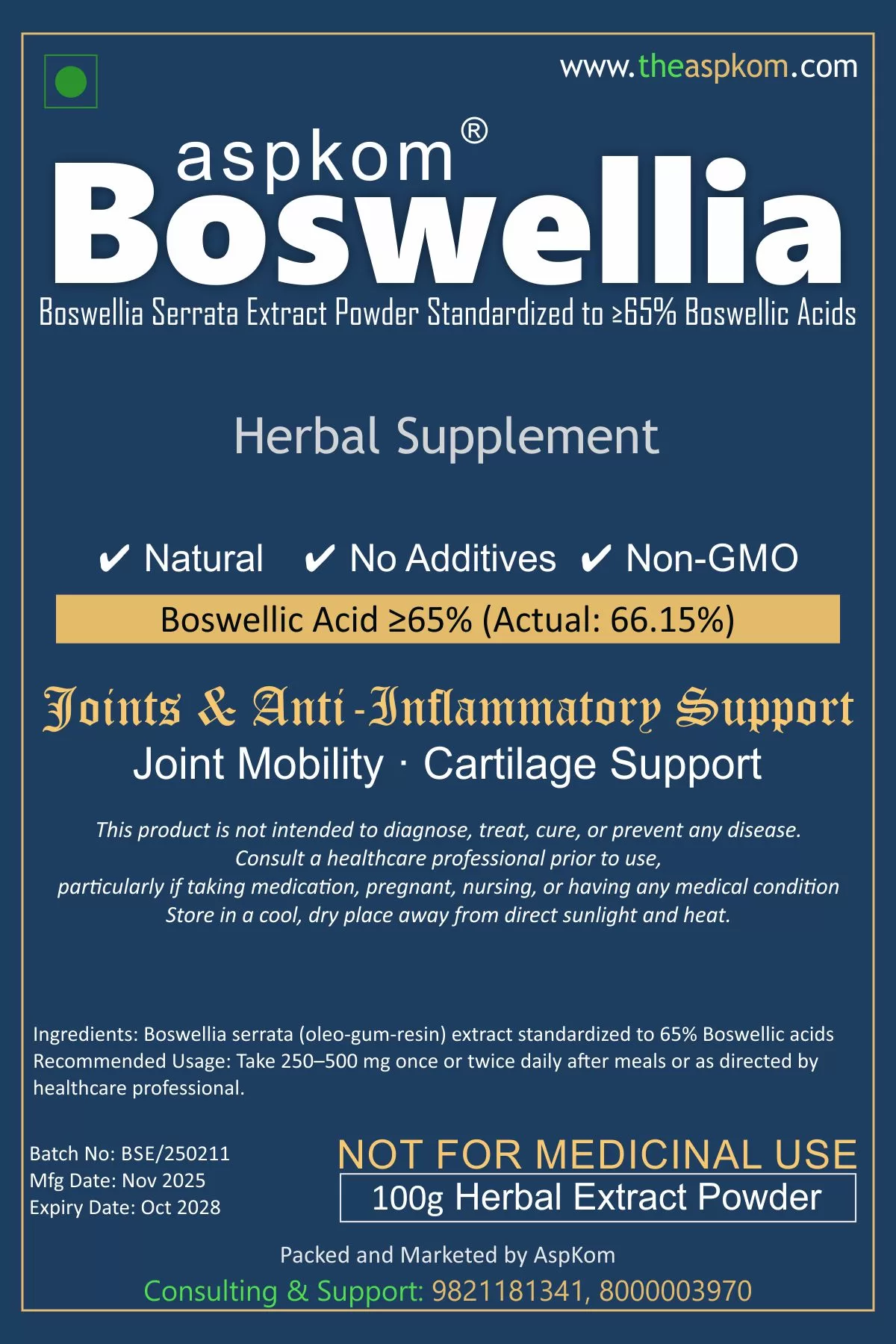
Boswellia serrata resin contains pentacyclic triterpenes (boswellic acids) that interact with inflammatory signaling cascades such as 5-lipoxygenase and matrix-degrading mediators involved in joint tissue turnover. This biochemical modulation is associated with support for joint comfort, flexibility, and movement in individuals experiencing mechanical or age-related joint stress. Standardized extracts (≈65% boswellic acids) are typically used in daily wellness routines targeting mobility and activity tolerance.
Typical intake ranges from 250–500 mg extract once or twice daily with meals to aid absorption of lipophilic triterpenes. Bioavailability may improve when co-administered with dietary lipids or formulated with phospholipids. In nutraceutical stacks, Boswellia is often combined with curcumin, collagen peptides, vitamin C, or MSM to provide complementary support for connective tissue matrix and inflammatory balance, offering broader joint-wellness coverage than single-nutrient approaches.
[aspkom_consult_button]
What Boswellia Supports (Indications)
Boswellia serrata extract is primarily positioned for joint comfort, mobility, connective tissue resilience, and inflammatory balance.
Its activity centers on leukotriene-mediated inflammatory pathways and cartilage-degrading enzymes.
Key Indication Areas
| Area | Typical Presentation |
|---|---|
| Activity or age-related joint stress | Load discomfort, reduced flexibility |
| Morning stiffness phenotype | Stiff joints after rest |
| Tendon / ligament strain | Movement discomfort |
| Cartilage wear trajectory | Mechanical joint sensitivity |
| Exercise micro-inflammation | Post-activity stiffness |
| Gut-linked inflammatory tone | Joint + gut sensitivity |
| Synovial swelling tendency | Joint fullness sensation |
| Mobility limitation | Reduced ease of movement |
How Boswellia Works Clinically
Boswellic acids (especially AKBA) act on lipid inflammatory mediators and connective-tissue catabolic enzymes.
Core Mechanisms
| Mechanism | Clinical Meaning |
|---|---|
| 5-lipoxygenase modulation | Reduces leukotriene-driven joint signaling |
| MMP / elastase regulation | Protects cartilage & connective matrix |
| Synovial mediator balance | Supports joint fluid quality |
| Neutrophil signaling modulation | Reduces stiffness perception |
| Gut leukotriene modulation | Lowers gut-joint inflammatory spillover |
Which Type of Boswellia Extract for Which Use
Different extracts behave differently.
| Extract Type | Best For |
|---|---|
| ≥65% total boswellic acids | General joint wellness |
| High-AKBA (20–30%) | Stiffness & inflammatory tone |
| Full-spectrum resin | Gut-joint axis & permeability |
| Phospholipid complex | High bioavailability needs |
| Fine-particle extract | Faster onset support |
Synergy — What Makes Boswellia Work Better
Boswellia performs best in multi-pathway joint stacks.
Evidence-Logic Synergies
| With | Why |
|---|---|
| Curcumin | Complements leukotriene + cytokine pathways |
| Collagen peptides | Provides cartilage matrix substrate |
| Vitamin C | Collagen synthesis cofactor |
| MSM | Connective sulfur support |
| Omega-3 | Reduces inflammatory substrate load |
| Probiotics | Gut-joint axis normalization |
Anti-Synergy — When Effects Reduce
Some contexts blunt Boswellia response.
| Factor | Why |
|---|---|
| Very high omega-6 diet | Excess inflammatory substrate |
| Fat-free intake | Poor triterpene absorption |
| Dysbiosis / antibiotics | Alters boswellic metabolism |
| Chronic NSAID use | Overlapping pathways |
| End-stage joint loss | Structural damage dominant |
Bioavailability — Hidden Practical Insights
Boswellic acids are lipophilic triterpenes with unique absorption behavior.
| Factor | Practical Insight |
|---|---|
| Take with meals | Bile improves absorption |
| With fats | Lymphatic uptake ↑ |
| Phospholipid forms | 3–7× higher AKBA levels |
| Smaller particles | Faster dissolution |
| Chronic use | Synovial tissue accumulation |
Use & Typical Intake
| Form | Typical Daily Amount |
|---|---|
| 65% extract | 250–500 mg 1–2× daily |
| High-AKBA | 100–250 mg 1–2× |
| Phytosome | Lower equivalent dose |
Best taken after meals containing fat.
Contra-indications & Sensitive Groups
| Group | Reason |
|---|---|
| Pregnancy | Leukotriene-uterine signaling unknown |
| Anticoagulant therapy | Mediator interaction potential |
| Pre-surgery | Inflammatory cascade role |
| Active GI ulcer | Resin acids irritation |
| Severe liver disease | Triterpene metabolism |
| Immunosuppressed | Immune modulation |
Where Boswellia Is Clinically Distinct
| Aspect | Boswellia Serrata Extract | Typical Joint Nutraceuticals | Clinical Implication |
|---|---|---|---|
| Primary inflammatory pathway | Leukotriene (5-LOX) modulation | Cytokine (NF-κB, COX) or structural | Targets different inflammatory axis |
| Tissue target | Synovium + cartilage enzymes | Cartilage matrix or systemic | Acts at inflammatory source |
| Enzyme effects | ↓ MMP, elastase, hyaluronidase | Minimal enzyme modulation | Slows connective breakdown signaling |
| Mediator class affected | Lipid inflammatory mediators | Cytokines or nutrients | Complements other agents |
| Structural support | Indirect (anti-catabolic) | Direct substrate (collagen, GAGs) | Preserves existing tissue |
| Fluid environment | Synovial mediator balance | Little effect | Supports joint lubrication dynamics |
| Onset pattern | Weeks (tissue accumulation) | Varies (often slow) | Progressive functional change |
| Best symptom profile | Stiffness, inflammatory load | Structural degeneration | Phenotype-specific utility |
| Stack compatibility | High (orthogonal pathway) | Often overlapping | Ideal for combinations |
| Distinction vs NSAIDs | Modulates LOX without COX block | COX inhibition dominant | Different inflammatory branch |